
Do You Need a Visa to Visit Dubai? Entry Rules for 2026 Explained
Planning a trip to the futuristic cityscapes of Dubai brings up one crucial question: do you need a visa? The short answer is yes, every traveller needs some form of entry permit. However, for many nationalities, this process is as simple as getting a stamp in your passport upon arrival, at no cost.
For others, a pre-arranged visa is essential. Navigating the rules can feel confusing, but this guide provides a clear framework for 2026. We’ll explain who can get a visa on arrival, who needs to apply in advance, and how to choose the right visa for your trip.
- The Core Rule: Every non-GCC national requires a visa to enter the UAE. The key difference is whether you get it automatically on arrival or must apply for it beforehand.
- Passport Validity: Regardless of your visa status, your passport must be valid for at least six months from your date of entry. This is a non-negotiable rule enforced by all airlines and UAE immigration.
- Official Authority: All entry permits and visas for the UAE are issued and regulated by the Federal Authority for Identity and Citizenship (ICP).
Dubai vs. UAE Visas: Is There a Difference?
A common point of confusion for first-time travellers is whether they need a specific "Dubai visa." In reality, there is no such thing. The United Arab Emirates has a unified visa system covering all seven emirates: Abu Dhabi, Dubai, Sharjah, Ajman, Umm Al Quwain, Ras Al Khaimah, and Fujairah.
When you receive a visa for Dubai, you are actually getting a UAE entry permit. This means you can land at Dubai International Airport (DXB) and freely travel to see the Sheikh Zayed Grand Mosque in Abu Dhabi or the mountains of Ras Al Khaimah. Your entry stamp allows you to move between all seven emirates without any internal borders or checks.
Who Can Enter Dubai Visa-Free?
The term "visa-free" is slightly misleading. It typically refers to nationalities that are eligible for a free visa on arrival. The only truly visa-free travellers are citizens of the Gulf Cooperation Council (GCC) countries.
- GCC Citizens: Nationals of Saudi Arabia, Kuwait, Oman, Bahrain, and Qatar can enter the UAE with their national ID card or passport and do not require a visa.
- Visa on Arrival: Many nationalities—including those from the UK, USA, Canada, Australia, and most of Europe—receive a free visa stamped in their passport upon arrival. We cover this in more detail in our UAE entry expansion guide
- Diplomatic Passport Holders: Holders of diplomatic or service passports from various countries may have special visa waiver agreements. These are specific and should be confirmed with the relevant embassy before travel.
Visa on Arrival Eligibility: Can You Get Your Stamp at the Airport?
For many travellers, the visa process is seamless. If your passport is from an eligible country, you simply proceed to the immigration counter upon landing at Dubai or Abu Dhabi airport. The immigration officer will stamp your passport with a visa valid for a specific duration. There are no forms to fill out and no fees to pay.
Eligibility is based on your nationality (the passport you hold), not your country of residence. You can confirm your specific requirements using a visa eligibility checker to get a definitive answer.
There are two main categories of visa on arrival:
The 30-Day Entry Stamp Countries
Passports from a wide range of countries, including the United Kingdom, United States, Canada, Australia, New Zealand, China, and Japan, are granted a 30-day visa on arrival. This visa allows you to stay in the UAE for up to 30 days from your entry date.
Historically, this visa came with a 10-day grace period, but regulations can change. It is always best to assume your visa is valid only for the 30 days stated on the stamp to avoid any risk of overstay fines. If you wish to stay longer, you can typically apply for an in-country extension without needing to leave the UAE.
The 90-Day Multiple Entry Stamp
Passport holders from most European Union countries, as well as several others like Argentina and Brazil, are granted a 90-day multiple-entry visa on arrival. This is not a single 90-day stay. The rule is you can stay for a maximum of 90 days in total within any 180-day period.
This is perfect for frequent travellers who use Dubai as a hub, but it requires you to track your days carefully. The 180-day period begins from your first day of entry. If you exhaust your 90 days, you must wait for the 180-day window to reset before you can use the visa-on-arrival facility again. If you need to stay longer, you must apply for a pre-arranged visa.
Pre-arranged UAE Visas: If You Aren’t Eligible for On-Arrival
If your nationality is not on the visa-on-arrival list, you must apply for a visa before you travel. This includes passport holders from countries like India, Pakistan, the Philippines, Egypt, and many others. Fortunately, the process for 2026 is almost entirely digital, and you rarely need to visit an embassy.
To get a pre-arranged visa, you need a sponsor in the UAE. This isn't as complicated as it sounds. Your sponsor is simply the entity that applies for the visa on your behalf. This can be:
- An airline (like Emirates or Etihad), but only if you fly with them.
- A hotel, but only if you have a confirmed and paid booking.
- A registered travel agency or visa service provider, like eVisas.io.
The Digital Application Process
Using a dedicated visa service is the most flexible and reliable option. The process is designed for speed and simplicity. You will typically need to provide:
- A clear, colour scan of your passport’s information page.
- A recent, passport-style digital photograph with a white background.
- Sometimes, a copy of your flight booking confirmation.
Modern services use AI-powered document verification to instantly check if your photo and passport scan meet the strict requirements of UAE immigration, significantly reducing the risk of rejection due to simple errors.
Why Use a Professional Visa Service?
While official government portals exist, they can be complex and offer limited support. A professional service acts as your expert guide, ensuring your application is submitted correctly the first time.
- Avoid Common Rejection Errors: Simple mistakes like a blurry photo or a typo in your name can lead to instant rejection. An expert review service catches these issues before submission.
- 24/7 Support: Immigration rules don't stick to office hours. If you have an urgent question or need status updates, a 24/7 support team is invaluable.
- Clear, All-Inclusive Fees: Professional services provide a single, transparent fee that includes all government charges, processing fees, and taxes. There are no hidden costs.
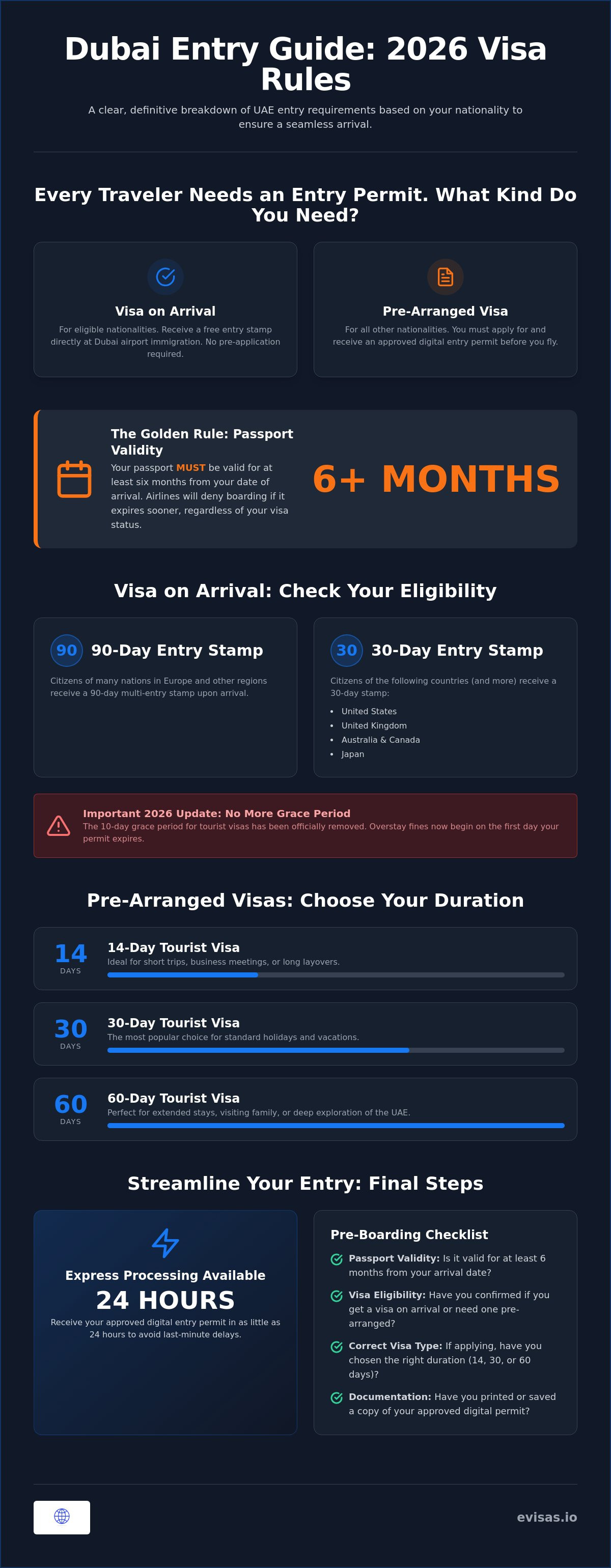
Choosing Your UAE Visa: A Detailed Comparison for 2026
If you need to apply for a visa in advance, the UAE offers a range of options tailored to different travel needs. From short stopovers to extended holidays, selecting the right one is key to a smooth trip. Here’s a breakdown of the most common tourist visas.
Transit Visas (48-Hour and 96-Hour)
- Who It’s For: Travellers with a layover in Dubai or Abu Dhabi who want to leave the airport and explore for a short period.
- Duration: Valid for 48 hours (2 days) or 96 hours (4 days) from entry.
- Key Feature: These are specifically for transit passengers and must be arranged in advance, often through your airline or a visa service. They are single-entry and cannot be extended.
14-Day Service/Tourist Visa
- Who It’s For: Ideal for short business trips, attending a conference, or a quick holiday.
- Duration: Allows a stay of up to 14 days.
- Key Feature: This single-entry visa is a cost-effective choice for travellers with a fixed, short itinerary.
30-Day Tourist Visa (Single or Multiple Entry)
- Who It’s For: The most popular option for holidaymakers and those visiting friends or family.
- Duration: Allows a stay of up to 30 days.
- Key Feature: You can choose between a single-entry visa or a multiple-entry visa. The multiple-entry option is perfect if you plan to use Dubai as a base for short trips to nearby countries like Oman. Learn more in our complete UAE Multiple Entry Visa Guide.
60-Day Tourist Visa (Single or Multiple Entry)
- Who It’s For: Perfect for extended vacations, long-term family visits, or for those who want to explore the UAE more deeply without a tight deadline.
- Duration: Allows a stay of up to 60 days.
- Key Feature: Like the 30-day visa, this is available in both single and multiple-entry formats, offering maximum flexibility for longer travel plans. It is often more cost-effective per day than extending a 30-day visa.
Avoiding Entry Delays: Express Processing and Final Checklist
What if you realise you need a visa at the last minute? A forgotten detail or a sudden change of plans can be stressful, but it doesn’t have to ruin your trip. This is where express visa services become essential.
For urgent travel, eVisas.io offers an express processing tier that can secure your approved UAE visa in as little as 10 hours. This premium service bypasses standard queues, ensuring your application gets priority attention. It's the ultimate solution for travellers who need to fly tomorrow.
Apply for your UAE Tourist Visa online with eVisas.io
Common Visa Rejection Reasons
To ensure a smooth application, avoid these common pitfalls:
- Poor Quality Scans: A blurry passport copy or a low-resolution photograph is the number one reason for rejection. Ensure your documents are crisp and clear. - Name Mismatches: Your name on the application form must match your passport exactly, including any middle names. - Previous Overstays: If you have a history of overstaying a previous UAE visa, your new application may be flagged or denied.
Your Pre-Flight Checklist
Once your visa is approved, run through this final checklist before heading to the airport:
- Check Passport Validity: Confirm your passport is valid for at least six months from your entry date.
- Print Your e-Visa: While a digital copy on your phone is usually accepted, carrying a printed copy is a reliable backup.
- Verify Visa Details: Double-check that your name, passport number, and date of birth are correct on the visa document.
- Travel Insurance: Ensure you have travel insurance that covers your entire stay in the UAE.
Frequently Asked Questions (FAQs)
Can I get a Dubai visa on arrival for a 60-day stay?
No, standard visas on arrival are issued for either 30 or 90 days, depending on your nationality. If you are eligible for a 30-day visa on arrival and want to stay for 60 days, you will need to enter on the 30-day visa and then apply for an in-country extension.
How much does a Dubai tourist visa cost in 2026?
The cost varies based on the visa duration (14, 30, or 60 days), entry type (single or multiple), and processing speed (standard or express). Visa on arrival for eligible nationalities is free. For pre-arranged visas, costs typically range from around $90 USD for a short-stay visa to over $250 USD for a longer, multiple-entry visa.
What is the fastest way to get a visa for Dubai if I fly tomorrow?
The fastest way is to use an express visa service. Services like eVisas.io can process and deliver an approved UAE tourist visa in as little as 10-24 hours, making it possible to secure your travel authorisation even for a last-minute flight.
Do US passport holders need a visa for Dubai for a one-week holiday?
No, travellers holding a United States passport do not need to apply for a visa in advance for a one-week holiday. They will receive a free 30-day visa on arrival when they land at the airport in the UAE.
Can I visit Abu Dhabi with a Dubai tourist visa?
Yes. A visa for Dubai is a visa for all of the UAE. It allows you to travel freely between Dubai, Abu Dhabi, and all other emirates.
What happens if my Dubai visa expires while I am still in the country?
If you overstay your visa, you will be subject to daily fines. The first day of overstay has a higher fine, followed by a standard daily penalty for each subsequent day. It is crucial to either exit the country or extend your visa before it expires to avoid fines and potential future entry restrictions.
Is a transit visa required for a 5-hour layover at Dubai International?
If you do not leave the airport's transit area, you do not need a visa. You only need a transit visa if you plan to pass through immigration to enter the city during your layover.
Do children need their own visa for Dubai?
Yes, every individual, including infants and children, must have their own visa. They must be travelling on their own individual passport to receive a visa on arrival or to have a pre-arranged visa issued.
Official UAE visa facts
Verified from our live 30 Days Single Entry Tourist Visa listing — no assumptions.
Required documents
- Valid Passport (+6Months Validity)
- Passport Back Page
- Photo
- UAE Visa / ID of Sponsor/Relative
- Flight itinerary
- Hotel reservation / Rent Agreement
Eligibility requirements
- Valid Passport (+6Months Validity)
- Passport Back Page
- Photo
- UAE Visa / ID of Sponsor/Relative
- Flight itinerary
- Hotel reservation / Rent Agreement